
by Emily Steves, @SeeEmilyPlay
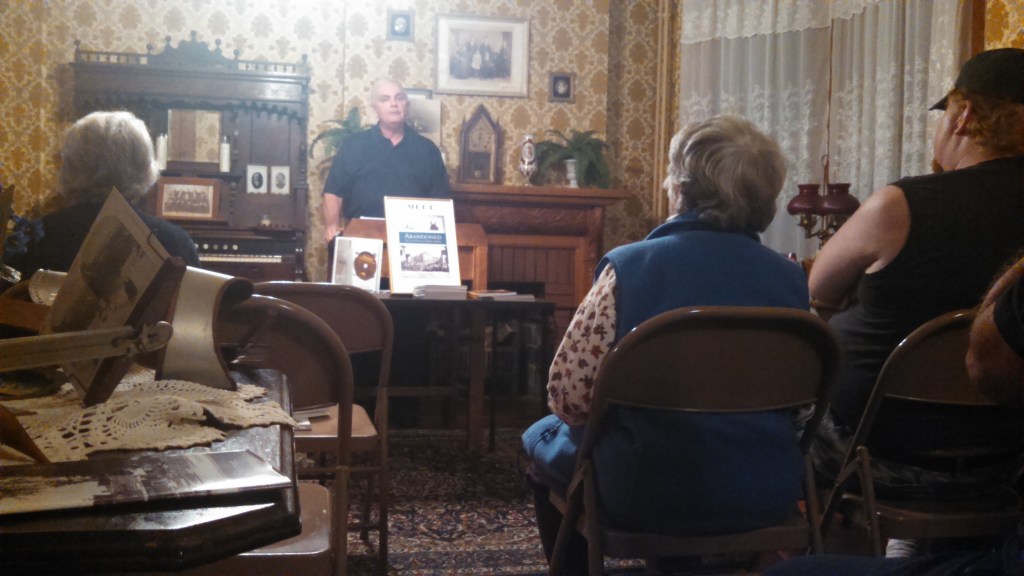
The audience in Miner’s Cabin, Franklinville, held onto Michael T. Keene’s every word as he described the Irish Potato Famine and its ultimate effect on the United States.
Keene referenced his book, “Abandoned: The Untold Story of Orphan Asylums” as he spoke to the Ischua Valley Historical Society on Oct. 2, noting how the Irish emigrated to escape starvation and the spread of typhus, an infectious disease spread by rodents.

“It was not uncommon to find entire families – infected with the disease – dead on the roadside,” he said.
The Irish traveled on ships dubbed “Coffin Ships,” aptly named for what they became for many on the voyage from Ireland to the United States to find more fruitful lives. But, according to Keene, they found lives far from fruitful.
“They slept in alleyways, cellars and even sewers,” Keene said, referring to orphaned Irish children in the city. “The age of orphanage building began.”
In New York City, the need for orphanages was clear. “So perilous and neglected was the life of a child in the Five Points,” he said. In packed basement apartments, children spent the entirety of their childhoods underground. Something needed to be done.
“In ‘Abandoned,’ I write about eighteen orphanages in New York State,” Keene said.
He also highlighted visionaries whose actions were instrumental in the building of these orphanages as they established them upstate away from the harsh living conditions in the city.
“They could have lived lives of leisure, but they spent their time bettering the lives of children,” said Keene.
Keene spoke of Western New York visionary, the Rev. Nelson Baker, and how he handwrote 10,000 letters to Catholic women across the country, asking for donations of 25 cents a year to keep an orphanage and protectory running in Lackawanna. Baker’s legacy, he added, lives on at the Our Lady of Victory Basilica in Lackawanna.
Keene went on to discuss the Orphan Train Movement, Charles Loring Brace’s idea for moving orphans from closed-in city orphanages to farms in the Midwest. The orphan trains were run for nearly 100 years from the mid-1800s to the mid-1900s.
“Local newspapers would announce ‘Homes Wanted For Orphans,’ ” Keene said, saying the separation between the movement and indentured servitude was in the contracts for fairness families had to sign.
Keene said 250,000 children “rode” the orphan train, and of that number, around 50 to100 are left.
“I just got an email from an author who said one of the survivors just celebrated her 105th birthday,” he said.
Keene covers heavy topics in his books, from mysteries to murders, and in January, plans to release a book about female serial killers in the 19th century.
“One of the challenges when you put together a 45-minute presentation is you have to leave stuff out,” Keene said on the phone after his talk. “It’s all great stuff as far as you, the writer, are concerned, but when you talk about it, you can’t talk about everything. You try to give everyone just a slice.”
Writing is a new career for Keene, who is retired from a 25-year career as a financial adviser, and it is something he really enjoys.
“If I wanted to, I could play golf every day, but that’s not I envisioned my retirement,” Keene said. “Doing what I did last night – giving talks – that’s fun.”
 Emily M. Steves: Portfolio of Work
Leave a comment